
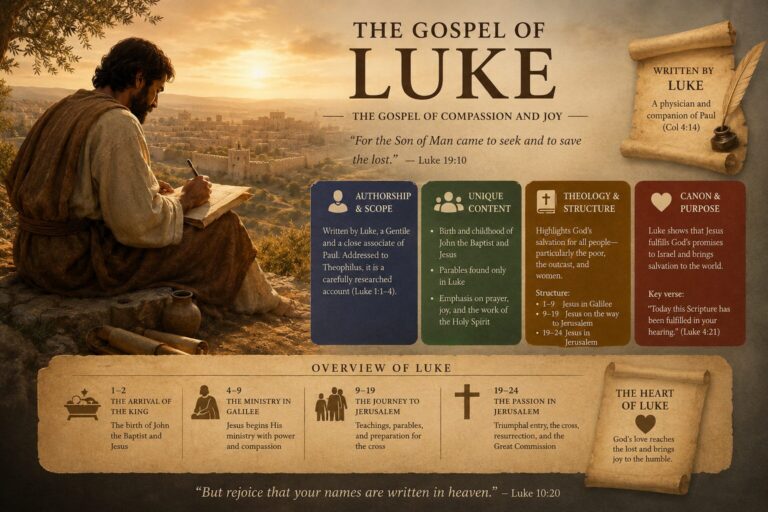
For anyone serious about how to study the Bible — not just what it says, but why you can trust it.
Most Christians have been told to have faith. Fewer have been told that faith has evidence behind it.
The Gospel of Luke is one of the strongest cases in the New Testament for the historical reliability of Scripture. Luke wasn’t writing devotional poetry. He was writing history — and he said so. Understanding why Luke can be trusted doesn’t diminish faith. It deepens it. It gives you the kind of bible knowledge that holds up under pressure, in a skeptic’s conversation, in a season of doubt, in a small group bible study when someone asks a hard question you weren’t expecting.
This is the kind of deeper bible study the Bible Mastery App is built for — not just memorize bible verses and move on, but to understand what you’re memorizing, why it was written, and why the ground beneath it is solid.
Here are five facts about Luke’s Gospel that the best bible study resources rarely put together in one place.
1. Luke Explicitly Claims Eyewitness Sources — and Uses Legal Vocabulary to Say So
Most readers glide past Luke 1:1-4 to get to the Christmas story. That’s a mistake. Those four verses are arguably the most important sentences in the gospel, because they tell us how Luke worked.
Luke writes that his account was delivered by αὐτόπται (autoptai) — a Greek word meaning firsthand eyewitnesses. This isn’t ordinary vocabulary. It’s the term used by Hellenistic historians and legal writers to describe someone who saw an event with their own eyes, as opposed to someone who heard about it secondhand. The Roman historian Polybius uses it. So does Josephus. Luke is placing himself in the tradition of rigorous ancient historiography, not religious legend.
He also tells us he followed everything ἀκριβῶς (akribōs) — with precision, carefully, in order. And he names his purpose: so that Theophilus (and by extension, us) might have ἀσφάλεια (asphaleia) — certainty, firm footing, unshakeable ground.
Luke wasn’t asking readers to take his word for it. He was citing sources. He names real, identifiable people: Joanna the wife of Chuza (Luke 8:3), Manaen the foster-brother of Herod (Acts 13:1), and the unnamed “we” companions of Paul who appear later in Acts. These are the ancient equivalent of footnotes — people still alive when the text circulated who could be questioned and cross-examined.
For anyone asking how to understand the Bible at a deeper level, this is the place to start: Luke presents himself not as a mystic but as a researcher. He expects scrutiny.
2. Luke’s Precision in Acts Has Been Confirmed Repeatedly by Archaeology
Luke and Acts are a two-volume work by the same author to the same recipient. This matters because Acts is the most archaeologically testable document in the New Testament — and Luke’s track record there reflects directly on the reliability of his gospel.
Luke uses precise, city-specific titles for local officials throughout Acts. These titles were not standardized across the Roman Empire. They varied by province, by city, and by era — and they changed over time. A forger writing decades after the fact, or a legend-builder with no firsthand knowledge, would almost certainly have gotten them wrong.
He didn’t.
- In Philippi, Luke calls the rulers stratēgoi (magistrates, Acts 16:20) — confirmed as the correct title for a Roman colonia.
- In Thessalonica, Luke uses politarchai (Acts 17:6) — a term previously unknown in classical literature, dismissed by critics, then confirmed by multiple inscriptions found in the city using exactly that word.
- In Cyprus, Luke calls Sergius Paulus anthypatos (proconsul, Acts 13:7) — critics argued Cyprus was an imperial province under a legate, not a proconsul. Later inscriptions proved Cyprus had been transferred to senatorial status, making Luke’s title precisely correct at that exact moment in history.
- In Malta, Luke calls Publius the prōtos (first man, Acts 28:7) — Maltese inscriptions confirm this was the exact local honorific used on the island.
F.F. Bruce and classical historian Colin Hemer catalogued dozens of these confirmations in The Book of Acts in the Setting of Hellenistic History (1989). The pattern is consistent: what looked like errors turned out to be precision. For anyone comparing the best bible study app options or looking for something beyond surface-level bible overview content, this kind of bible history and bible context matters enormously.
3. The Census Objection That Skeptics Loved Has Largely Collapsed
Luke 2:1-3 places the birth of Jesus during a Roman census under Quirinius. For over two centuries, this was one of the most popular objections to Luke’s reliability. Critics argued that Quirinius didn’t govern Syria until AD 6 — years after Herod’s death — making a census during Jesus’ birth chronologically impossible.
The objection is far weaker now than it once was.
First, Egyptian papyri (including P.Lond. 904) have confirmed that Romans conducted periodic household census registrations requiring people to return to their place of origin — exactly the mechanism Luke describes. This had been dismissed as implausible. It turned out to be standard Roman administrative practice.
Second, an inscription known as the Titulus Tiburtinus suggests that Quirinius may have held an earlier military command in the Syrian region during the Herodian period — before his more famous governorship. A dual tenure would resolve the chronological tension entirely.
Third, the Greek word πρώτη (prōtē) in Luke 2:2 can be rendered “before” rather than “first,” giving a translation of “this registration took place before Quirinius was governor of Syria” — which eliminates the problem grammatically.
None of this is fully settled in scholarship. But the confident dismissal of Luke’s census account that characterized 19th and early 20th century criticism has not aged well. The trajectory of the evidence consistently moves toward Luke, not away from him. For daily bible study and bible study plan purposes, it’s worth knowing that what looks like a contradiction in Scripture often looks very different a century later.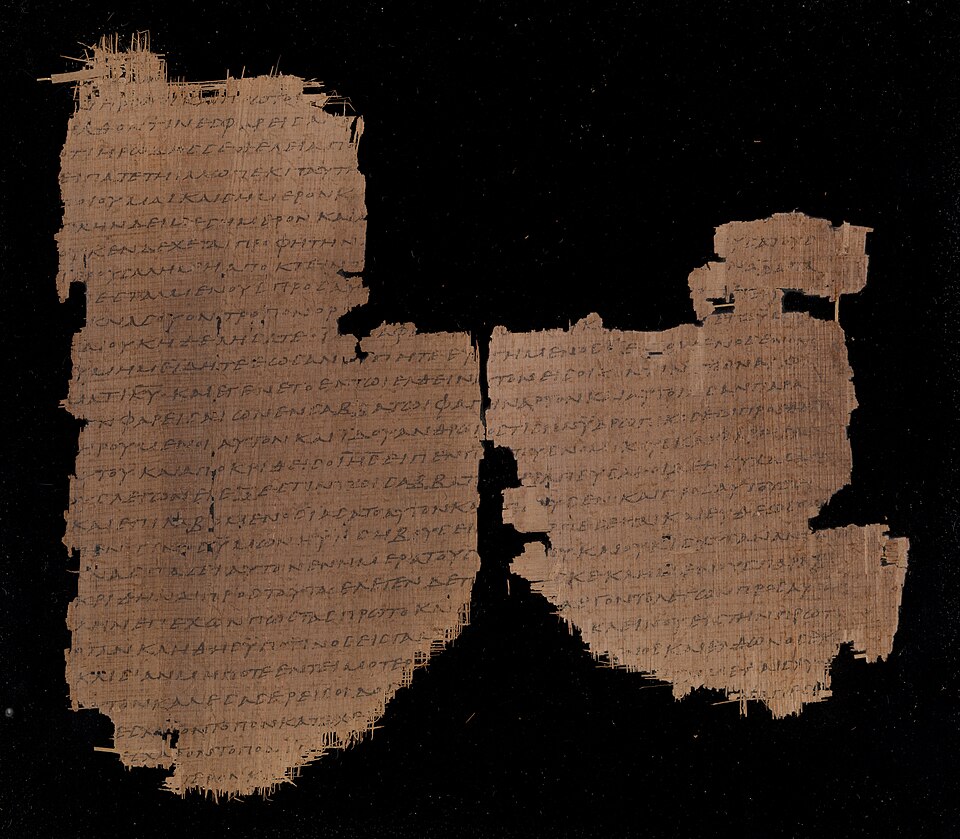
4. The “We” Passages in Acts Are Among the Strongest Internal Proofs of Eyewitness Authorship
Beginning at Acts 16:10, something unusual happens in the narrative. Without explanation or introduction, the text shifts from third person (“they sailed,” “he went”) to first person plural: “we sought to go into Macedonia,” “we put out to sea,” “we came to Philippi.”
This happens four times in Acts (16:10-17; 20:5-15; 21:1-18; 27:1-28:16). Each time, the shift occurs during a travel segment. Each time, the narrative returns to third person when the author apparently departed from the group.
No one has produced a convincing explanation for this pattern other than the obvious one: the author was present. He is not importing a “we source” from another document — the grammar, style, and vocabulary are identical to the rest of Acts throughout. The author was a traveling companion of Paul, a first-generation figure who was there.
Richard Bauckham, in Jesus and the Eyewitnesses (2006), argues that this kind of named and traceable proximity to events is precisely what distinguishes the gospel tradition from legend. Legends don’t write themselves into the narrative with quiet first-person pronouns in travel journals. Eyewitnesses do.
This is the kind of bible commentary insight that transforms how you read the New Testament — not as a collection of ancient religious texts, but as documents written by people who were present, who knew that what they were recording was true because they had seen it.
5. Luke Was Written Earlier Than Most People Assume — Within Living Memory of the Events
Acts ends abruptly. Paul is under house arrest in Rome. No verdict. No martyrdom. No mention of the deaths of Peter (c. AD 64) or James (AD 62). No reference to the fall of Jerusalem (AD 70) — one of the most catastrophic events in Jewish history, the kind of thing no Christian writer could ignore if it had already happened.
The silence is significant. The most natural explanation is that Acts was written before these events occurred — around AD 62. If Acts was written by AD 62, Luke’s gospel was written before that (Acts 1:1 explicitly calls Luke “the first account”). That places the Gospel of Luke within approximately 30 years of the crucifixion.
This is not a conservative fringe position. John A.T. Robinson — a critical scholar by no means committed to evangelical conclusions — argued for precisely this chronology in Redating the New Testament (1976) on purely literary grounds.
Thirty years is not a long time. The people Luke interviewed — the αὐτόπται, the eyewitnesses of Luke 1:2 — were not ancient history to him. They were living sources. Men and women who had walked with Jesus, heard him teach, watched him die, and encountered him after the resurrection. Luke could sit across a table from them.
For those who want to not just memorize bible verses but actually retain scripture and build long term bible memory, this matters. You are not memorizing myths. You are memorizing the testimony of witnesses, recorded within their lifetimes, by a careful historian who tells you exactly what he did to verify it.
The Cumulative Case
Any single one of these facts can be debated in isolation. Taken together, they form a pattern that demands explanation.
Verified government titles across a dozen cities in three provinces. Confirmed Roman census procedures. Eyewitness vocabulary in a formal historiographical prologue. First-person travel narrative embedded in the text. An early date placing the author within living memory of the events.
The most economical explanation for all of this is the one Luke himself gives in his opening lines: he was a careful researcher with access to the people who were there, writing to give his reader firm, unshakeable ground.
Luke 1:4 — ἀσφάλεια. Certainty. That’s what he promised. That’s what the evidence supports.
The Bible Mastery App is built for this kind of deeper bible study — helping you move from surface familiarity to genuine scripture mastery through spaced repetition bible learning, bible flashcards, and a daily bible study plan designed to help you retain scripture for life, not just for Sunday. If you’re ready to know the Bible better and never forget what you’ve learned, explore the app and start your bible study plan today.