Why Most Bible Study Habits Fail After a Few Days
You start strong.
A new Bible reading plan.
A fresh sense of motivation.
A commitment to be consistent.
Then life happens.
A missed day turns into two.
Two turns into a week.
And before long, the habit is gone.
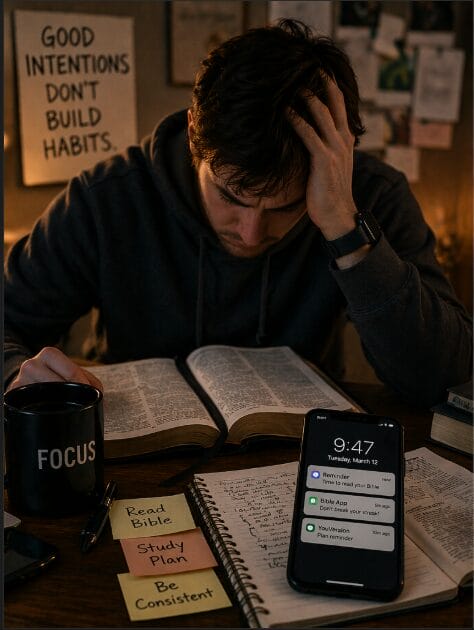
This cycle is extremely common—and deeply discouraging.
But the issue is not simply a lack of discipline.
Most Bible study habits fail because they are built incorrectly from the start.
The Real Reasons Bible Study Habits Break Down
1. You rely on motivation instead of structure
Motivation is powerful—but temporary.
It comes in waves:
- After a sermon
- At the start of a new year
- During a difficult season
But habits built on motivation collapse when motivation fades.
Proverbs 21:5 says:
“The plans of the diligent lead surely to abundance…”
Consistency is built through planning, not just intention.
2. The goal is too big
Many people try to do too much too quickly:
- “I’m going to read the Bible in a year”
- “I’ll study for 30 minutes every day”
Those goals are not wrong—but they are often unrealistic at the start.
When the goal feels heavy, avoidance begins.
3. There is no feedback loop
If you cannot see progress, your brain disengages.
Compare:
- Fitness apps → show streaks, progress, milestones
- Bible study → often feels invisible
Without visible progress:
- motivation drops
- consistency breaks
- the habit feels meaningless
4. You don’t know what to do each day
Decision fatigue kills habits.
Questions like:
- “What should I read today?”
- “Where do I even start?”
Lead to delay—and eventually avoidance.
5. The experience feels like effort, not reward
If Bible study feels like:
- homework
- obligation
- mental strain
You will avoid it—even if you care deeply.
The habit must include small wins and reinforcement.
What Actually Builds a Consistent Bible Habit
Consistency is not about trying harder.
It is about designing a system that makes consistency natural.
1. Start smaller than you think
Instead of:
- 30 minutes a day
Start with:
- 5–10 minutes
This removes resistance.
Zechariah 4:10 says:
“Do not despise the day of small beginnings.”
Small, consistent action builds momentum.
2. Remove friction
Make Bible study easy to start:
- Keep your Bible visible
- Use a simple plan
- Eliminate setup time
The easier it is to begin, the more likely you are to follow through.
3. Attach it to an existing habit
Link Bible study to something you already do:
- After your morning coffee
- Before bed
- Right after brushing your teeth
This is called habit stacking.
It removes the need to “decide” each day.
4. Track your progress
Progress creates motivation.
Even simple tracking helps:
- Days studied
- Verses learned
- Sessions completed
Seeing growth reinforces behavior.
5. Use short, structured sessions
Instead of random reading:
Follow a simple flow:
- Review something you’ve already learned
- Study one small passage
- Reflect or apply
Structure removes uncertainty.
6. Build in reinforcement
Consistency increases when there is reward:
- Completion satisfaction
- Streaks
- Progress milestones
This is not about trivializing Scripture.
It is about reinforcing faithfulness.
Hebrews 12:11 says:
“For the moment all discipline seems painful rather than pleasant, but later it yields the peaceful fruit of righteousness…”
The reward often comes after consistency is established.
A Simple Daily Bible Habit That Works
Here is a realistic system:
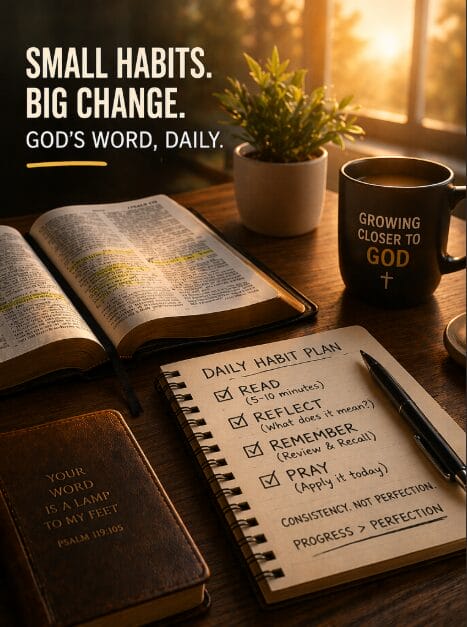
Total time: 5–10 minutes
- Review 2–3 previous verses or notes
- Read one short passage
- Write one takeaway
- Reflect or pray briefly
That’s it.
Done consistently, this builds:
- understanding
- retention
- spiritual growth
Why Most People Quit (And How to Avoid It)
People quit when:
- they miss a day
- they feel behind
- they feel like they’ve failed
The solution:
Never miss twice.
If you miss one day, return the next.
Do not restart.
Do not overcompensate.
Just continue.
The Biblical Pattern of Consistency
Psalm 1 describes the person who delights in God’s Word and meditates on it “day and night.”
This is not about intensity.
It is about regular, repeated engagement.
Faithfulness over time produces transformation.
A Better Way Forward
If you want to overcome inconsistent Bible reading:
- Lower the barrier to start
- Remove daily decision-making
- Keep sessions short and structured
- Track visible progress
- Focus on consistency, not perfection
Final Thought
Consistency is not built in dramatic moments.
It is built in quiet, repeated choices.
A few minutes a day—done faithfully—will do more for your spiritual life than occasional bursts of effort.
Luke 16:10 says:
“One who is faithful in a very little is also faithful in much…”
Start small.
Stay consistent.
Let it grow.