
Many people want to memorize Scripture—but they run into a frustrating cycle:
They repeat a verse over and over…
They finally get it…
And then a few days later, it’s gone.
Others go the opposite direction. They focus on understanding the passage deeply—but never actually retain the words.
The goal is not one or the other.
The goal is both: fast memorization and deep understanding.
Why Most Scripture Memorization Doesn’t Last
There are three common breakdowns:
1. Memorizing words without meaning
If you don’t understand a verse, your brain has nothing to anchor it to. It becomes fragile and easy to forget.
2. Repeating instead of recalling
Reading a verse 10 times feels productive—but it’s passive.
Memory strengthens when you try to recall without looking.
3. No structured review
Even well-memorized verses fade quickly if they aren’t revisited.
Without a system, forgetting is inevitable.
What “Faster” Memorization Actually Means
Faster doesn’t mean rushing.
It means:
- Fewer repetitions needed
- Stronger recall
- Longer retention
In other words: you remember it once—and keep it.
A Better Way to Memorize Scripture
This method is designed to help you learn quickly without losing depth.
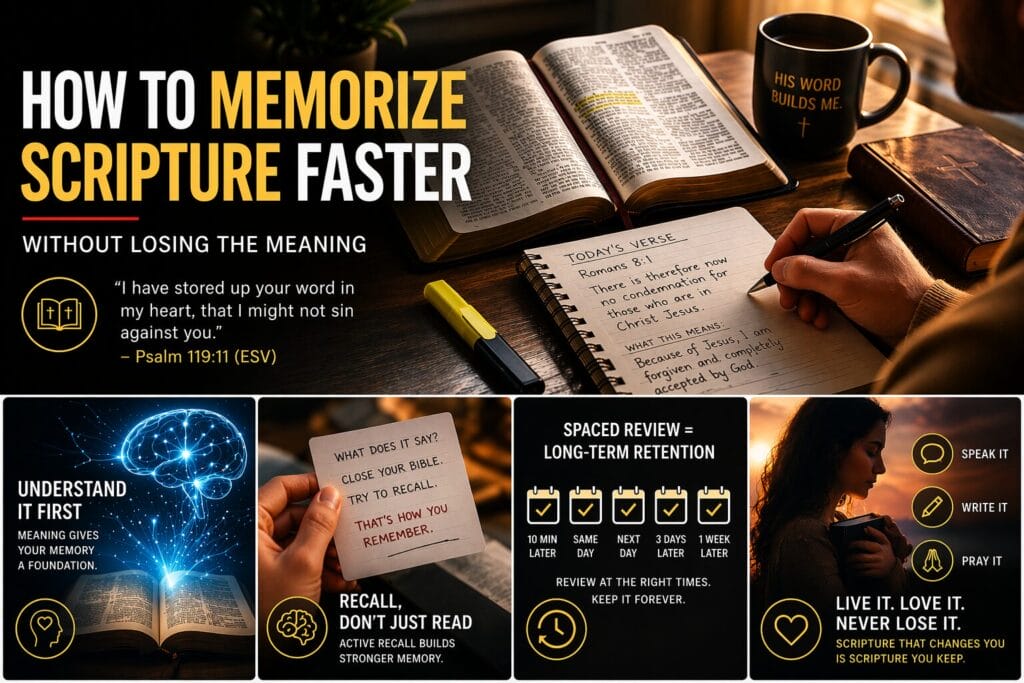
Step 1: Understand the verse first
Before memorizing, ask:
- What is happening in this passage?
- Who is speaking?
- What is the main idea?
Write one simple sentence:
“This verse means…”
Understanding creates structure. Without it, memory collapses.
Step 2: Break the verse into parts
Do not try to memorize the entire verse at once.
Example (Romans 8:1):
- “There is therefore now no condemnation”
- “for those who are in Christ Jesus”
Smaller segments are easier to retain and recombine.
Step 3: Use active recall immediately
Close the Bible and try to say it.
You will likely struggle—that’s the point.
That effort strengthens memory far more than rereading.
Step 4: Repeat with spacing
Instead of cramming, review at intervals:
- After 10–15 minutes
- Later the same day
- The next day
- A few days later
- One week later
This pattern dramatically increases retention.
Step 5: Attach meaning and application
Ask:
- When would I need this verse?
- How does it apply to my life?
Memory becomes stronger when it is connected to real situations.
Step 6: Speak, write, and pray it
Use multiple forms:
- Say it out loud
- Write it from memory
- Turn it into prayer
Each layer reinforces recall.
A Simple 5–10 Minute Daily Routine
You don’t need long study sessions.
Try this:
- Review 2–3 previously learned verses
- Learn 1 new verse (with meaning)
- Test recall without looking
- Apply or pray through it
Consistency matters more than volume.
Why Meaning Matters So Much
Scripture is not just information to store—it is truth to live.
Psalm 119:11 says:
“I have stored up your word in my heart, that I might not sin against you.”
Notice the purpose:
- Not just memory
- But transformation
When meaning is ignored, memorization becomes mechanical.
When meaning is central, memorization becomes powerful.
The Biblical Pattern: Meditation
Joshua 1:8 gives a clear model:
“This Book of the Law shall not depart from your mouth, but you shall meditate on it day and night…”
This includes:
- Speaking it (recall)
- Thinking on it (understanding)
- Repeating it (reinforcement)
This is not rushed memorization.
It is deep, repeated engagement.
Why Most People Quit Memorizing Scripture
Not because they don’t care—but because:
- They forget quickly
- It feels inefficient
- They don’t see progress
When memorization feels ineffective, motivation disappears.
The solution is not more effort.
It is a better system.
A Smarter Way Forward
If you want to memorize Scripture faster:
- Start with meaning, not repetition
- Use recall, not just rereading
- Review strategically, not randomly
- Stay consistent, even in small sessions
This produces something different:
Not verses you once knew—
But Scripture that stays with you.
Final Thought
Psalm 1 describes the person who meditates on God’s Word “day and night.”
That kind of repetition is not burdensome—it is transformative.
When Scripture is both understood and remembered, it becomes:
- Available in temptation
- Ready in conversation
- Present in prayer
- Anchored in the heart
That is the goal.